Athlon Thunderbird Overclocking (Page 1/5)
Posted: September 4, 2000
Written by: Tuan "Solace" Nguyen
Introduction
You’ve just picked up that new Duron or Thunderbird and already you feel that you must have more power. What drives this need for more power? The strange thing about it is that the shiny new processor you’ve just purchased is instantly not enough for you. What more do you want? Isn’t a 7th generation architecture good enough for you as it is?
You’ve probably read all the guides on how to overclock AMD’s Duron processor. The little marvel can reach 998MHz from a base speed of 700MHz. That’s nothing short of amazing. So far, everything is Duron. Where are all the Thunderbirds? Let’s take a short look at the difference between a Duron and a Thunderbird.
Differences
AMD’s Duron and Thunderbird processors are both based on the same Athlon core. What does this mean for you as a user? 7th generation processor architecture on even the lower end Durons. Everyone knows Celerons overclock great and now Durons do too. Why can’t regular processors targeted at the high-end overclock as well?
Commonly, value chips had less L2 cache than high-end chips but they ran at full core speed and that made them easier to overclock. Now that chips from both Intel and AMD have moved to the socket interface, all cache is on die and running at full core speed. What does this mean? Higher quality cache that can attain higher speeds.
Speaking of cache, that’s another difference between the Duron and the Thunderbird. The Duron only contains 64KB of on-die L2 cache whereas the Thunderbird contains 256KB of on-die L2 cache. Also, the cache on the Thunderbird is 16-way set associative whereas the Duron only has a 2-way set cache. That there gives the Thunderbird a lead over the Duron.
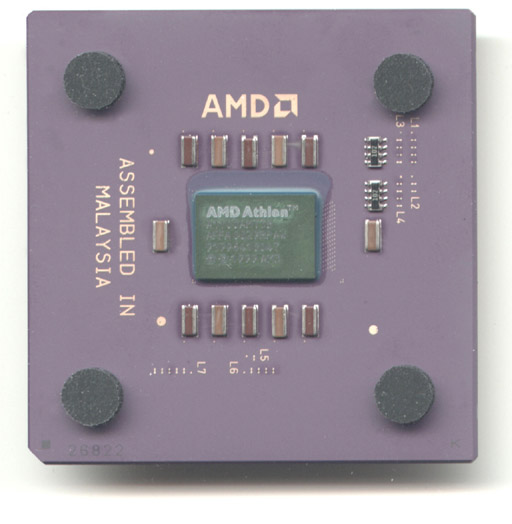
"Enhanced" Athlon with Aluminum interconnects
Above you see the Thunderbird processor. Notice that the L1 bridges (top right) on the chip are dark. This is because I connected the L1 bridges using a regular HB pencil. That’s right, a regular pencil was used. I didn't discover this personally; I got the idea from an article online. You can read it here. If you are looking for Thunderbirds alone, there are two difference types you may want to look out for. The first bunch uses aluminum interconnects and the second bunch uses copper interconnects. To tell which processor is based on which type of metal, all you have to do is examine the core. If the color on the core surface is a green color, then the processor uses aluminum interconnects. If the color on the core surface is blue, then the processor uses copper interconnects.
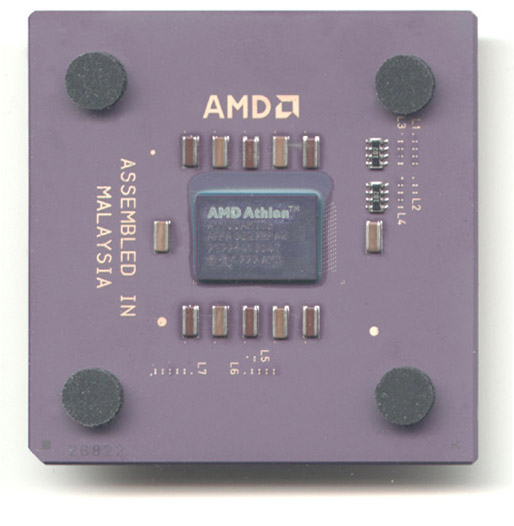
"Enhanced" Athlon with Copper interconnects
So which core gives you the best performance? Copper conducts electricity better than aluminum, therefore all signals will be able to transfer back and forth at least 15% faster than it does through aluminum. If you obtain a copper based Thunderbird you automatically gain some percentage in performance, but it is probably not noticeable. Also, copper interconnects should yield better heat dissipation. You might also want to note that only Thunderbirds above 900MHz use copper interconnects. Does a copper Athlon overclock better than an aluminum Athlon though? We will see.
Next Page